Wire armouring lubrication
Unist's wire armouring lubrication solutions use Minimum Quantity Lubrication (MQL) to precisely deliver oil to the armour strip as it winds, before it passes through the guides and curler.
Integrates seamlessly with armouring lines:
Lube on demand – RPM-controlled application automatically adjusts to line speed, so you're never over- or under-lubricating
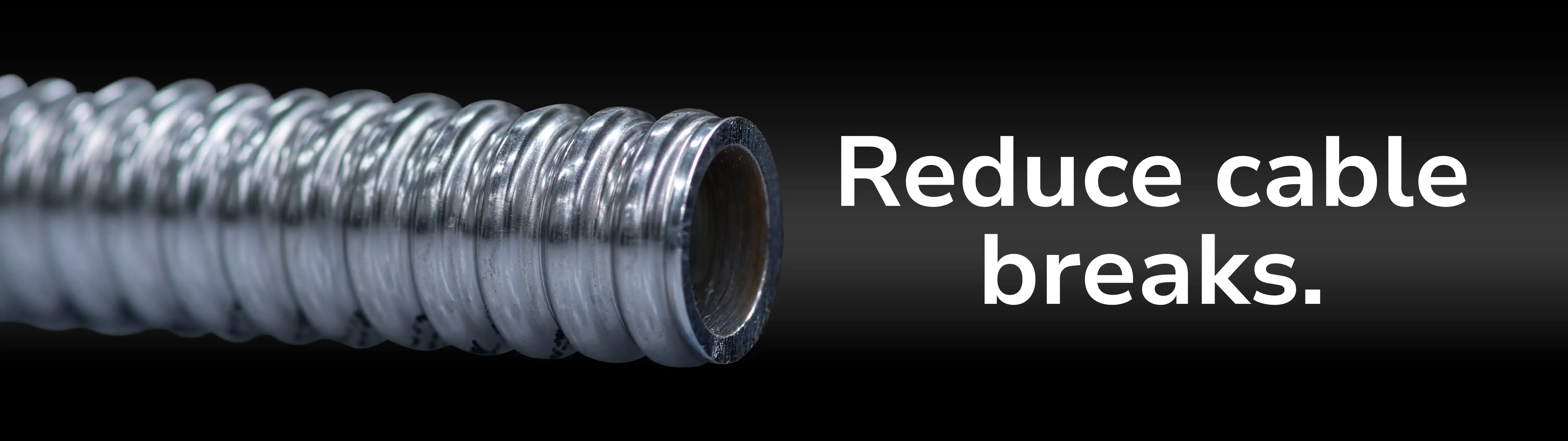
Reduce friction – Smoother windings mean fewer jagged edges, fewer breaks, and longer curler life
Less downtime – fewer breaks means fewer splices and less time spent rethreading dies
- 1-12 nozzle outputs
- Consistent output regardless of temperature or viscosity
- Seamless integration


Unist MQL capabilities
- Strip/Interlock armouring (BX, MC)
- Single Cage armouring
- Dual Cage armouring
- Planetary armouring
- Round wire
- Flat strip
- Interlocked strip
- Triangular strip
- Galvanized steel
- Aluminum
- Copper
- Stainless steel
- Energy/Power cable
- Instrumentation cable
- Coaxial cable
- Data cable
- Fiber optic cable
Why wire armouring lubrication matters
Wire armouring needs precise amounts of lubrication to prevent friction damage during winding without oversaturating the final product.
The friction problem
Armour wire runs under constant tension at speeds up to 1,300 RPM, winding through the cage, over the guides, and into the curler. That combination of speed and tight clearance creates intense friction. Insufficient lubrication shows up as:
- Jagged armouring edges
- Premature curler wear
- Wire breaks forcing a rethread

Why flood and pressure-based spray systems fall short
Flood and spray systems solve the friction problem but create new ones. Too much oil builds up inside the armouring and drips out of the finished wire after installation. It also means fog and a mess on the shop floor. The root cause: flood and spray apply a fixed rate. Armouring lines don't run at a fixed speed. Every line ramps up slowly before reaching full operating speed, so a rate tuned for full speed floods the wire early in the cycle.
How Unist MQL solves it
Pump cycle rate is tied directly to your machine's RPM. Speed up, and the system delivers more. Slow down, and it delivers less. The armouring gets exactly what it needs at the speed it's actually running, with no manual adjustment and no excess fluid to manage. This works for strip/interlock, single cage, dual cage, and planetary armouring.

Unist offers a variety of lubrication solutions for the wire industry.
Successful system installations:


Components of a Unist solution
Precisely apply lubricant based on machine line speed.

Compatible with popular armour interlocking fluids.

Wire armouring lubrication products


New line or retrofit? We have experience integrating our systems with leading armouring equipment across the industry.
Get consultation